Africa
Last and First MenAfrica is portrayed not as a single, continuous civilization but as a region repeatedly drawn into larger historical transformations. It becomes a destination for the Second Men’s expansion and encounter with another intelligent species, a theater of territorial division in the East–West War, and part of the Martians’ later occupation of Earth. These episodes link the continent’s history to changing centers of power beyond it, while also making Africa a setting for encounters that challenge human claims to exclusive intelligence and dominion.
Position in a Changing World
In the period after Europe’s decline, Africa was grouped with Asia as part of the eastern political system, opposed to the American-led federation and its dependencies. The division was not a simple reflection of common culture: the account distinguishes substantial differences among peoples within each system, while describing fear of the United States as a force drawing China and India together. Africa’s place in this alignment was therefore geopolitical as well as geographical, part of a broad eastern bloc formed in a world increasingly organized around rival continental systems.
This position became more concrete during the later conflict over fuel and political influence. Asia and North Africa formed the more geographically compact side, while the United States and its dependents possessed the stronger economic organization. The two sides entered the war with almost no conventional armament, but civilian aircraft were converted into weapons platforms. The conflict began violently, then slackened and continued for a quarter of a century. Africa was not merely adjacent to this war: by its conclusion, most of the continent was in American hands, while Egypt had become an uninhabitable no-man’s-land after South African forces contaminated the Nile’s sources. The fate of a river system thus became part of the war’s territorial and human consequences.
The Second Men’s African Expedition
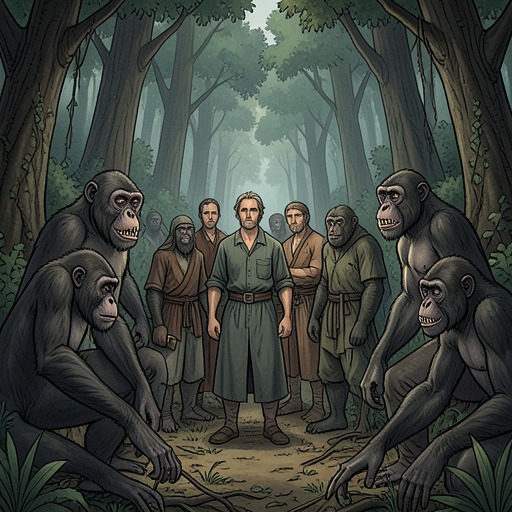
In a much earlier era, the Second Men’s expansion reached Africa by way of an expedition across the Hindu Kush. They had moved through a region extending from Afghanistan toward the China Sea, overrun India, and advanced into other lands. Their arrival in Africa brought them face to face with descendants of a ship’s crew that had left Siberia millions of years earlier. Those descendants had spread south through the Americas and crossed the Atlantic land bridge into Africa, where they had developed into a markedly different population from the Second Men.
The expedition also encountered the African Tree-Dwelling Apes, whose organization and practical ingenuity made them more than a local obstacle. They used weapons, coordinated their defense, and controlled groups of Sub-men, training them as laborers. The Second Men’s first small party had crossed the mountains in search of metals exposed by volcanic activity. The newcomers did not initially seek conflict, but the Apes attacked and destroyed the party; one man escaped to Asia. When he returned with a larger force, the Second Men did not launch a punitive campaign. Instead, they settled at the forest’s edge and gradually established communication and trade, eventually gaining permission to enter the region for a metallurgical survey. Africa is thus the setting for both a violent first contact and a subsequent accommodation between societies with sharply different forms of intelligence and power.
The account contrasts the Apes’ quick, adaptable skill within a narrow range with the Second Men’s greater capacity for judgment and sustained cooperation. Their African encounter gives that comparison a concrete setting: the Apes could initially overcome the human visitors, but the Second Men returned without allowing the first attack to dictate their longer relationship. The subsequent exchange made continued exploration possible without turning the episode into a campaign of revenge.
War, Partition, and Devastation
The later East–West War transformed Africa’s political map. American control spread across most of the continent, while Egypt’s condition was tied to the destruction of the Nile’s sources. The war’s effects were not limited to the frontiers held by either side. After the conflict, the disease known as American Madness spread into Asia and Africa. For a time, some degree of order remained in those regions; then the disease reached them as well, and the surviving traces of their civilizations disappeared. The account describes human settlement retreating to the world’s naturally fertile areas, with wilderness returning elsewhere.
This sequence connects military division to a wider collapse without suggesting that Africa alone caused or controlled the disaster. The continent was first partitioned within a global struggle and then caught in the spread of a catastrophe that erased civilization across regions. Its earlier status as part of a large eastern system offered no protection from either political subordination or biological devastation.
Martian Occupation and the Long View
More than fifty thousand years after the Martians first appeared, they established a permanent foothold on the Antarctic tableland and overran Australasia and South Africa. For centuries they held a large part of Earth’s surface, practiced a form of agriculture, studied terrestrial conditions, and devoted considerable effort to the liberation of diamonds. South Africa is the specifically named African region in this account of their expansion; the narrative does not describe a separate local campaign there.
Life on Earth nevertheless altered the Martians’ understanding of their own society. Some explorers recognized that terrestrial bipeds, though insensitive to radiation, were the planet’s intelligences. The colonists also came to see that research into terrestrial conditions and the practical organization of their settlement depended on private individuals, not simply on the collective Martian mind. Their reassessment weakened the authority of a revered super-individual and led to a spiritual renewal centered on mentality rather than radiation. Africa’s inclusion in the Martian foothold therefore belongs to a larger change in how the invaders interpreted both Earth and themselves.
Narrative Significance
Across these eras, Africa’s importance lies in the different forms of contact it concentrates. The Second Men arrive as explorers seeking metals and encounter societies that resist and negotiate with them; later powers treat the continent as territory within a worldwide political and military contest; and the Martians incorporate South Africa into an occupation that ultimately unsettles their assumptions about intelligence. The Nile’s role in the war and the African expedition’s turn from attack to exchange give the region distinct consequences within those histories. Africa’s recurring place in the account is consequently both geographic and analytical: it reveals how civilizations meet other populations, compete over resources, and discover limits to the systems through which they claim mastery.